The Question Point
You don’t just hear what people say. You decide what they mean.
A short reply feels rude. A pause feels dishonest. A confident answer feels true. “That should be fine” sounds like a commitment.
We all fill in what people leave unclear—often without realizing we are doing it.
Sometimes our interpretation is right. Sometimes it is not. The problem is knowing the difference before we react, decide or act.
Because what we think someone meant can influence who we trust, who we hire, what we believe, where we invest and when we walk away.
The Question Point teaches you how to catch that moment.
Learn to separate what happened from what you assumed, recognize what is still missing and ask the question that brings clarity.
See the difference
Someone says, “That should be fine.”
What it can feel like
They made a commitment.
What was actually established
They expect it may work. No owner, action or deadline was confirmed.
Ask this next
What must happen, who owns it, and when will it be complete?
One question turns an impression into information you can act on.
Your first interpretation may be right.That is not the same as having earned it.
Find out what your judgment does when the answer is not obvious.
Choose a five-situation Quick Check, about three minutes, or the full twenty-situation diagnostic for a more detailed picture. See your results immediately. No email address, account or purchase required.
Quick Check: 5 situations · About 3 minutes · Full Diagnostic also available
Already purchased? Log in to your course
This is not a personality test. It measures five learnable judgment skills used in work, relationships, money and everyday decisions.
The problem—and the skill that solves it
The mistake happens before the decision.
You notice something real—a pause, a short reply, a confident answer or a change in behaviour. Your mind supplies a meaning. Then you respond to that meaning as though it were part of what happened.
That moment between what you noticed and what you decided it meant is the Question Point.
What happens now
Your first interpretation takes control.
A vague answer becomes a commitment in your memory.
Silence becomes agreement, rejection or guilt.
Confidence becomes proof.
One change in behaviour becomes a judgment about the person.
What the course teaches you to do
Catch the moment before it controls the decision.
Recognize when a fact has quietly become a story.
Keep credible explanations open until evidence separates them.
Ask a neutral question that produces useful information.
Choose an action that fits the evidence, stakes and uncertainty.
What you leave able to do
Recognize the Question Point while it is happening—and use a repeatable method before an assumption affects a meeting, relationship, opportunity or important decision.
Five modules · 30 lesson stages · 25 core image investigations · 50 optional practice scenes · scene investigations · mastery checks · integrated challenge · final assessment · approximately 7–9 hours (pilot estimate)
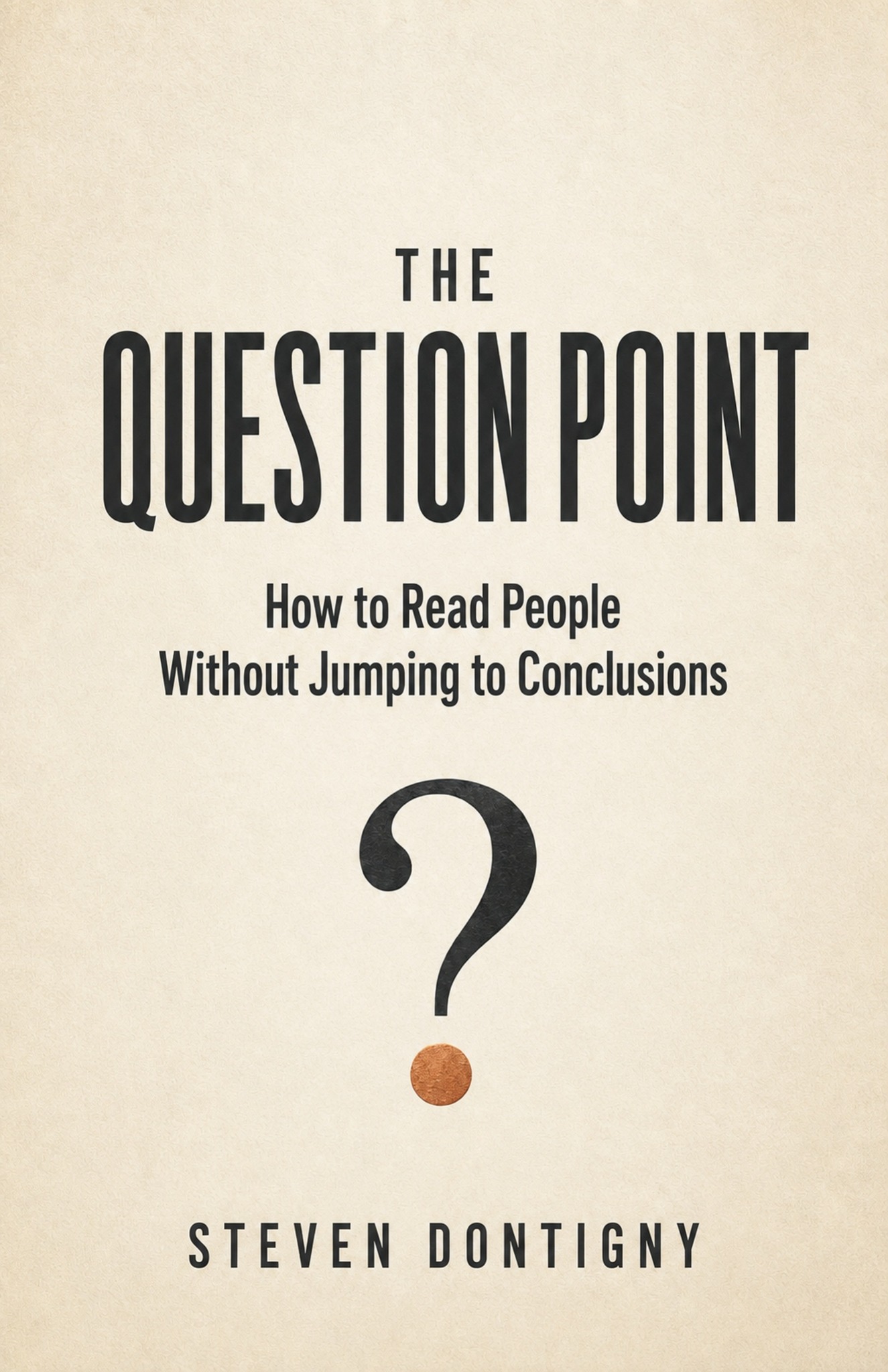
Read the method. Train the behaviour.
The book explains the ideas. The course builds the skill.
The Question Point introduces the real stories, principles and method behind the training. The course turns those ideas into decisions you can practise, test and use under pressure.
You do not need the book to complete the course. It provides additional stories, context and deeper reading for people who want to understand where the method came from.
Ready to see what your judgment does under uncertainty?
Take the free diagnostic, explore the complete course or review the practical questions before you begin.
Already purchased? Log in to your course